Spotify broke payout records in 2025, but the system is still starving independent musicians. For a young LatinX artist in the Midwest about to become a father, the blockchain isn’t just a buzzword—it’s the formula for survival.
By Dante Viscarra
Eleven billion dollars. That’s the massive check Spotify cut to the music industry in 2025. The headlines practically threw a parade for the streaming giant, celebrating the largest annual payment from any music retailer in history.
But if you’re an independent artist grinding it out in the real world, $11 billion sounds like a cruel joke. Why? Because you have to divide that pie among over 10 million active artists, and then let labels, distributors, and publishers take their massive bites before you ever see a dime.
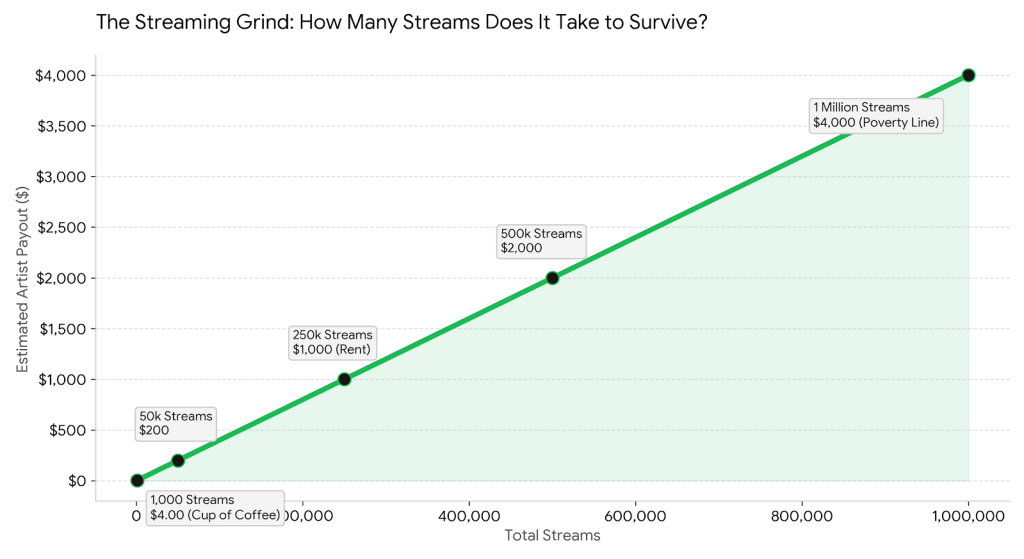
Let’s talk about the raw numbers. On average, a stream on Spotify pays out between $0.003 and $0.005. To make a modest $50,000 a year, you need roughly 12.5 million streams. That’s 34,250 streams every single day, just to hit a basic living wage before taxes.
And then there’s the “Pro-Rata” trap. Streaming platforms pool all subscription money globally and pay it out based on total platform stream share. If your Tía pays $10.99 a month and only listens to your indie acoustic tracks, her money doesn’t actually go to you. It gets funneled to the massive pop stars dominating the global charts. Add in Spotify’s 2024 policy that cuts off royalties completely for tracks with under 1,000 yearly streams, and the system starts looking less like a platform and more like a gatekeeper.
The Reality on the Streets: Meet Jose Ruiz
Jose Ruiz doesn’t care about global streaming metrics; he cares about buying diapers.
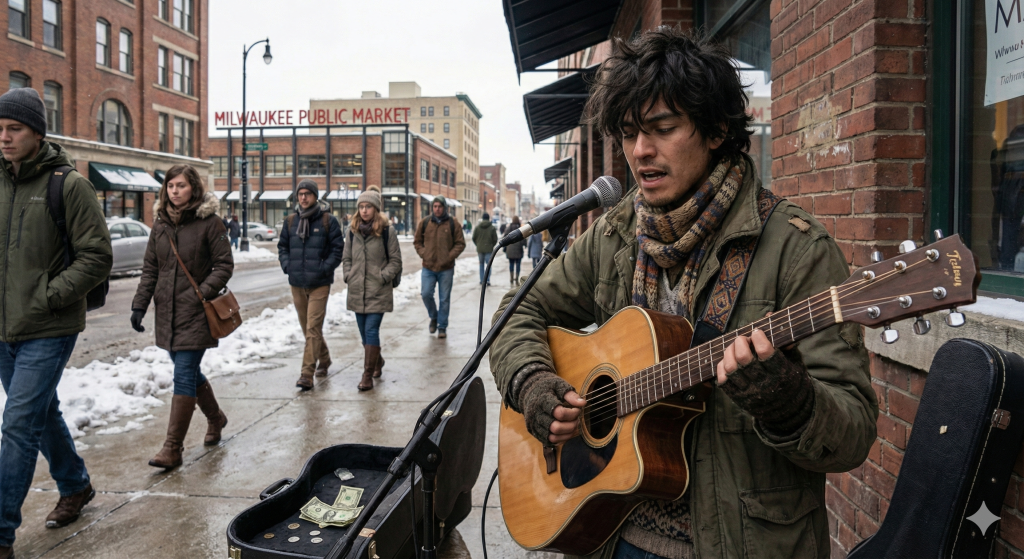
At 24, the Venezuelan guitarist has been playing professionally in pubs across Chicago and Milwaukee, busking on street corners to make ends meet. His sound is an infectious fusion of funk, cumbia, and guaguanco—the tropical rhythms of the Caribbean and Latin America. He’s put in his 10,000 hours, a journey that started at age 12 when his uncle Rigoberto handed him an old cuatro guitar and showed him the way.
Now, the stakes are higher. Jose and his partner are expecting their first child on November 23, 2026.
“It’s getting harder and harder to make a living as an artist these days. I write my own music and lyrics,” Jose tells MadisonVibra. “My goal is to help my family… simple things like buying diapers and formula. I do okay on the streets, but I need a more stable income.”
Despite his undeniable talent, Jose is entirely disconnected from the digital streaming world. He doesn’t even have the Spotify app on his phone. But his hesitation isn’t just about technology; it’s about ownership. “The scary part is uploading my original music into their platform and losing control. Once my music is in their system, I lose control.”
For artists like Jose, the traditional streaming model is a dead end. But the crypto and Web3 world offers a blueprint to bypass the middlemen entirely.
Two Web3 Solutions to Sustain the Hustle
If Jose wants to protect his art, keep total control, and build a stable income for his growing family, he needs to look past legacy tech and look toward the blockchain. Here are two ways Web3 can change his reality:
1. Decentralized Web3 Streaming Platforms
Instead of feeding his music into the traditional streaming machine, Jose can distribute his tracks on Web3 platforms like Audius, Emanate, or Tamago. These decentralized networks are built on the blockchain and are designed to strip away the middlemen.
- The Play: There is no 1,000-stream threshold to start earning. Artists are paid directly in native cryptocurrency tokens (like $AUDIO) for every play, which can be swapped for stable cash. Because there are no massive label payouts eating the margins, the revenue goes straight to the creator. Jose keeps his master rights, retains his creative control, and gets compensated fairly from stream number one.
2. Music NFTs (Digital Collectibles)
To secure a solid financial foundation before his baby arrives, Jose can mint his original funk-cumbia fusions as Music NFTs (Non-Fungible Tokens). Instead of chasing a million streams at $0.004 a pop, he can sell his music directly to his most loyal local fans as exclusive digital collectibles.
- The Play: If Jose sells just 100 limited-edition NFTs of his new track for $40 each, he makes $4,000 instantly. That same $4,000 would require a million streams on traditional platforms. Furthermore, smart contracts baked into the NFTs can guarantee him a percentage of royalties every time that digital track is resold in the future. It turns his listeners into investors and his art into a sustainable asset, all while he retains 100% ownership.
The Call to Action
The $11 billion streaming machine wasn’t built for independent, culturally rich artists like Jose Ruiz. It was built for the 1%.
But the tools to rewrite the rules are already here. To Jose, and to every young LatinX creator in the Midwest pouring their soul into their craft: don’t surrender your rights to a platform that views your art as background noise. Dive into the Web3 ecosystem. Mint your first Music NFT. Upload your next single to a decentralized streaming platform.
Take back your power, protect your ownership, and build a system where your music actually pays for the diapers. The blockchain is waiting.
