Legacy banks are taxing your remesas and blocking the AI revolution. Meet the Gen Z builders bypassing the system to code the $5 trillion internet of 2035.
Mike Hernandez knows the exact cost of legacy infrastructure. Every time he sends $1,000 in remesas to his retired parents in Guatemala, the system skims $40 off the top.
A first-generation college student in his second year of systems design and programming at Milwaukee Technical College, Mike is no stranger to troubleshooting. In high school, he was the guy fixing everyone’s software installations. Now, his focus has shifted to fixing a fundamentally broken financial loop.
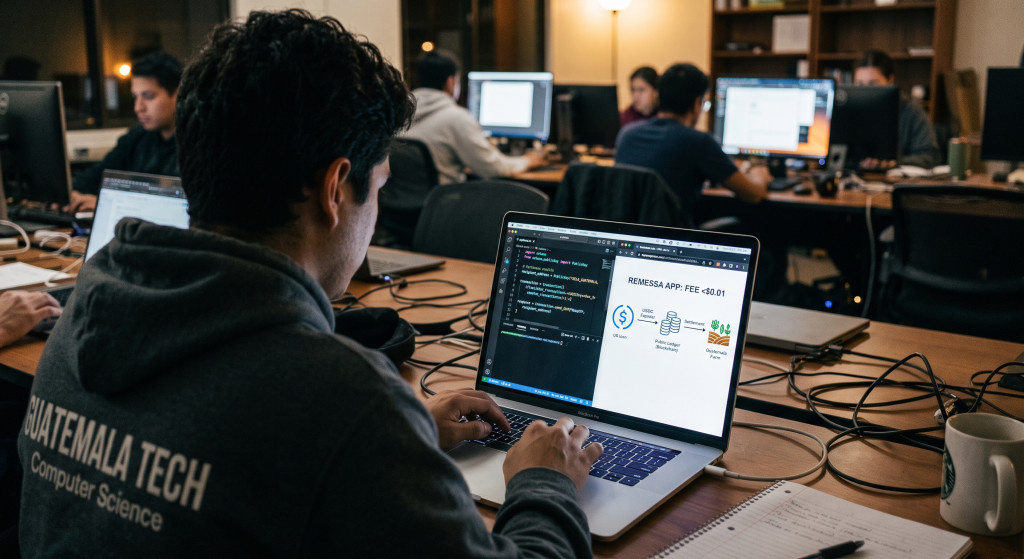
“My parents are now retired and went back to Guatemala. While they had some savings, they only saved in cash, and the little they had they invested in a small rancho in Xela, Guatemala,” Hernandez says. “I still help them and send the money every month… I’m looking right now to develop something that could help me save money, because I use Western Union and the fees are horrendous. When I ask around to some of my classmates and other Latino friends from Mexico and Colombia, they also face the same problem.”
The users Mike wants to build an app for are already active participants in the US economy. The majority of these senders have government-issued ITINs (Individual Taxpayer Identification Numbers) for their personal banking—because regardless of legal status, Uncle Sam cares about collecting taxes. They are in the system. They have bank accounts. Yet, they are still punished by legacy rails that charge exorbitant “Western Union taxes” and SWIFT fees just to move their own money across a border.
But as Mike dives deeper into his Python and technology structures classes, he’s realizing that the friction his community faces sending remesas is the exact same friction holding back the next multi-trillion-dollar digital revolution: the Machine-Native Economy.
At Consensus Miami 2026, the tech world put a name to this shift: “The Convergence.” It is the inevitable point where artificial intelligence and public blockchain rails merge. The reality is that the internet of 2035 won’t just be built for human clicks and plastic credit cards; it will be built for autonomous software agents transacting directly with one another.
And if the current banking system is this painful for human beings with government tax IDs, it is entirely impossible for machines.
Why Your AI Can’t Open a Chase Account
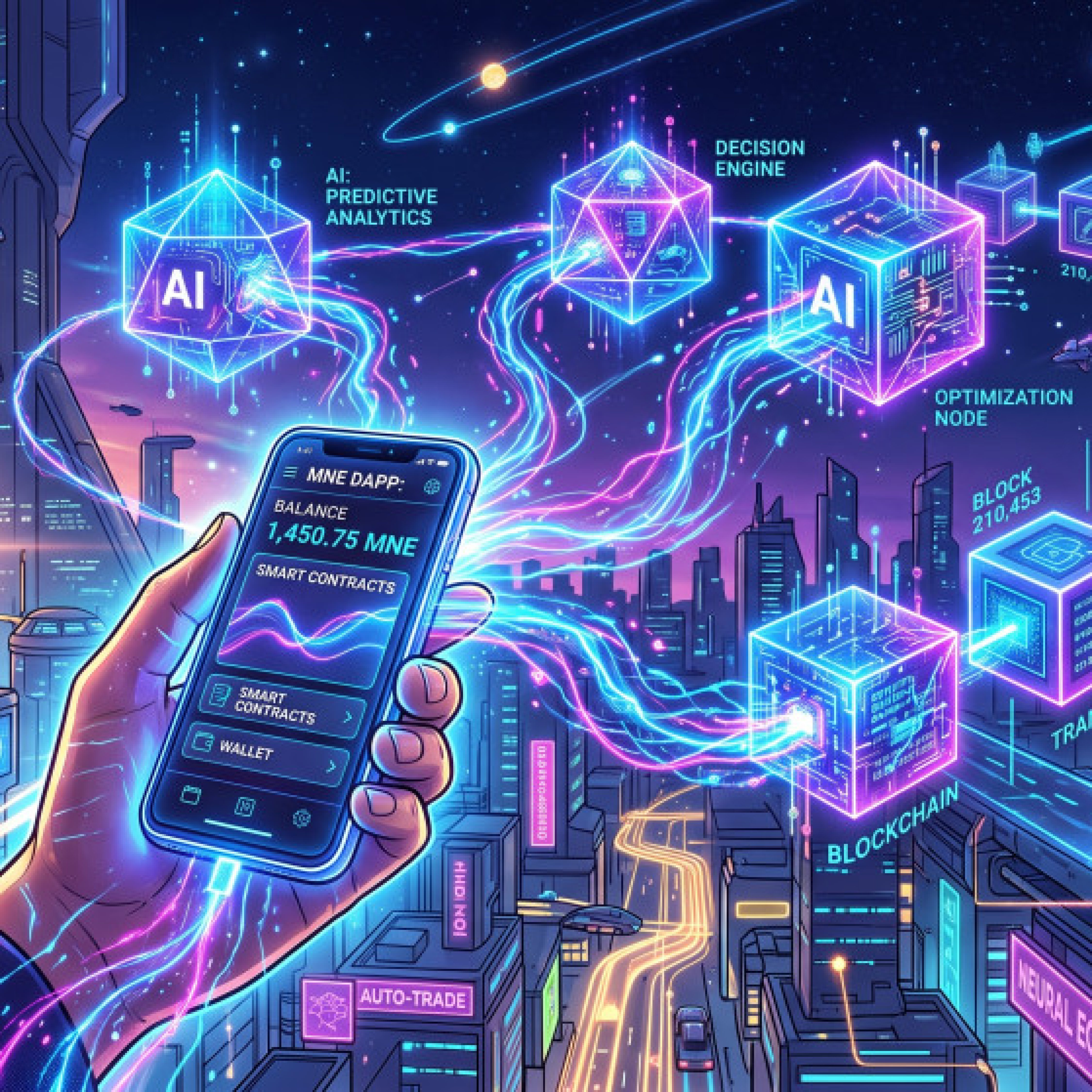
Imagine you build an autonomous AI agent to run the backend of your digital storefront. You want it to monitor your social ads, instantly spin up AWS cloud servers to handle traffic spikes, and hire a specialized sub-agent to edit promotional videos on the fly.
Your AI has the raw intelligence to execute all of this in milliseconds. But under our current financial system, your AI agent hits a brick wall:
- No SSN, No Account: It can’t pass Know-Your-Customer (KYC) laws to open a traditional bank account.
- Zero API Access: It can’t legally sign a user agreement with Stripe or PayPal.
- The Micro-Transaction Trap: If your AI needs to pay another AI $0.05 for a piece of data, traditional 30-cent flat swipe fees instantly bankrupt the transaction.
Christian Catalini, MIT professor and Founder of the Cryptoeconomics Lab, summarized this bottleneck perfectly on the Consensus stage: “Most agents today operate just as LLMs paired with a credit card. That’s assisted checkout, not true agentic payments. Real agentic payments begin when the AI is the counterparty.”
Smart Contracts: The Ultimate AI API
This is where the speculative noise of the crypto market fades away, and real utility takes over. To an autonomous software agent, a smart contract on a public blockchain isn’t a speculative meme—it is simply another API endpoint.

Public blockchains like Ethereum and Solana don’t care if a transaction is initiated by a human in Milwaukee sending a remesa, or a Python script running in a decentralized data center. By utilizing public ledgers, an AI agent can spin up a programmable crypto wallet in a few lines of code and settle funds globally in seconds.
Anatoly Yakovenko, Co-Founder of Solana, laid out the stakes for the infrastructure builders: “If AI agents are going to transact millions of times a second, they need a network that doesn’t choke. They need environments where fees are fractions of a cent, which is exactly what high-throughput chains are built for.”
For builders like Mike, this is the unlock. Using high-throughput chains and stablecoins (like USDC), the exact same technology that allows a trading bot to execute micro-transactions for fractions of a cent can be used to bypass legacy remittance fees entirely for everyday families.
The Trillion-Dollar M2M Hustle

For the young Latinx entrepreneurs and Gen Z builders reading MadisonVibra, the expiration of the altcoin bubble opens up massive software opportunities. The focus has entirely shifted toward building the physical and digital infrastructure that AI agents require to live, compute, and trade.
During the Convergence Stage panel at Consensus, Raoul Pal, Co-Founder and CEO of Real Vision, dropped a macro projection that recontextualizes the entire space: “AI agents will account for three-fifths (60%) of DeFi users within five years.” Pal noted that “cryptocurrencies function as ‘universal equity’ in the AI era—the native financial layer for a machine-driven economy.”
This Machine-to-Machine (M2M) economy is projected to reach between $3 trillion and $5 trillion by 2030. It will not run on paper checks or plastic cards. It will run entirely on tokenized dollars moving natively on-chain.
Building the Infrastructure of Tomorrow

The narrative that crypto lacks real-world utility is officially dead. It is the invisible plumbing required to sustain the next era of automated commerce—and it is the key to solving real-world, cross-border friction.
Alex Rodriguez, CEO of A-Rod Corp, perfectly captured this transition for the next wave of founders while speaking at Consensus: “The next generation of entrepreneurs aren’t just thinking local; they are thinking global and digital from day one. Understanding these new financial rails is how you stay ahead of the game.”
The architects of this new machine-native economy are already coding the future. The internet of 2035 belongs to those who build it today.
Consensus is Miami Beach on May 4-6, 2027.
You an register here https://consensus.coindesk.com/
Related posts:
 Chicago International Salsa Congress 2026 Fuego Candela Gusto
 Ascending the Fires of Legends: My Epic Hike up Acatenango and Fuego
 Beyond the $11 Billion Flex: Why Web3 is the Real Amplifier for Indie Artists
 The Shark Whisperer of Providencia: A Conversation with Dive Master Instructor Felipe Cabeza